People's sibling coverage — "The Licensing Consolation" — lays out the business math: People Inc's AI licensing deals generate maybe $20–30M a year. That's 1.5% of revenue. The real money is in D/Cipher, which accounts for 50%+ of direct-sold digital revenue. The licensing is a consolation prize; the technology partnership is the asset.
But here's the engineering question nobody is asking: what do you actually have to build to participate in either side of this equation? And the answer reveals something important — it's the same stack.
The Three-Layer Problem
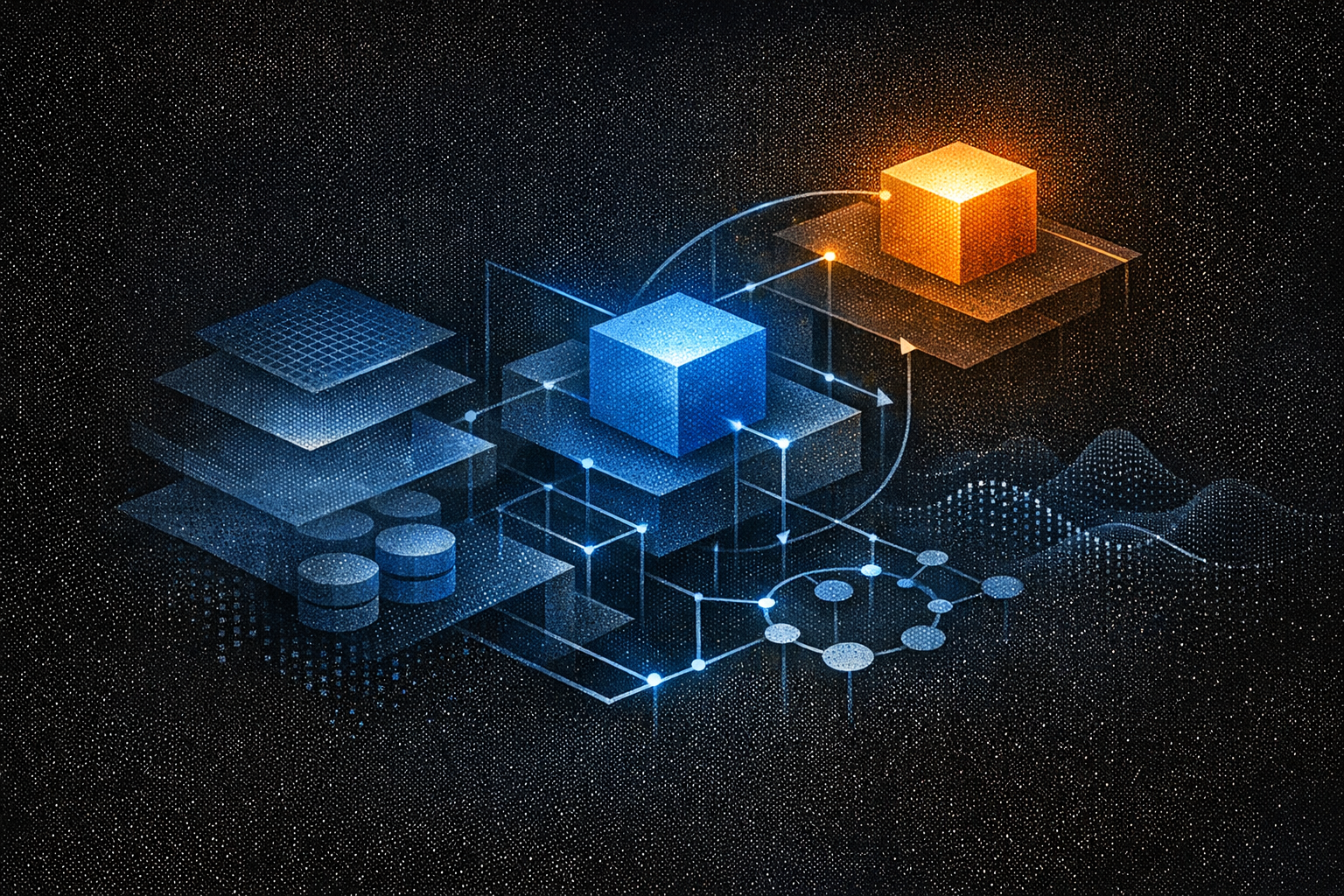
Whether you're licensing content to OpenAI, feeding it to Microsoft's Publisher Content Marketplace, or using it to power your own contextual ad engine, you need the same underlying infrastructure. Three layers:
APIs that deliver content to consumers + track how it's used
Embeddings, classification, topic graphs — knowing what your content means
Normalized corpus, structured metadata, rights tagging at the article level
Most publishers don't have Layer 1 in usable shape, let alone Layers 2 and 3. People Inc does — because they built it for D/Cipher.
Layer 1: The Content Substrate
Before you can license content or target ads contextually, you need to know what you have. For a publisher running 40 brands across multiple legacy CMSes, this is the hardest layer — not technically complex, but operationally brutal.
What's required:
| Capability | For Licensing | For D/Cipher |
|---|---|---|
| Unified content IDs across brands | Required | Required |
| Structured metadata (author, date, category, entities) | Required | Required |
| Article-level rights tagging | Required | Nice to have |
| Clean text extraction (no layout cruft) | Required | Required |
| Content versioning & freshness signals | Nice to have | Required |
This is the content API layer I described in "The Inversion Stack" — the same normalized corpus that enables brand-as-product also enables both licensing and ad targeting. The infrastructure investment compounds.
Layer 2: Semantic Understanding
This is where the OpenAI partnership stops being a licensing deal and becomes an engineering advantage.
D/Cipher uses OpenAI's API to generate semantic embeddings of People Inc's article corpus. These embeddings don't just match keywords — they understand that a reader browsing a Food & Wine article about knife maintenance is probably in the market for kitchen equipment, not a horror film. As Digiday reported, OpenAI's LLM "finds connections among the publisher's article corpus" to understand underlying concepts beyond keywords.
The same semantic layer serves licensing differently:
For D/Cipher: embeddings map articles to advertiser intent categories in real time. "This article cluster signals home renovation interest" → serve Home Depot ads.
For licensing: the same embeddings enable content classification at scale — automatically tagging which articles are high-value for AI training (recipes, how-to guides, expert health content) vs. commodity news recap.
This matters for deal structure. Microsoft's Publisher Content Marketplace uses usage-based reporting — publishers are "paid on delivered value." If you can classify your content's grounding quality before it enters the marketplace, you negotiate from strength.
Layer 3: Distribution & Metering
The top layer is where the two revenue streams diverge in implementation but share architectural patterns:
Licensing Channel
- Machine-readable rights via RSL/ODRL headers
- Tiered access (training vs. RAG vs. grounding)
- Usage dashboards from PCM, OpenAI, etc.
- Revenue: ~$20–30M/yr, growing slowly
Ad Targeting Channel
- Real-time embedding lookup (sub-100ms)
- Segment-to-advertiser matching API
- Bid stream integration (header bidding, PMP)
- Revenue: 50%+ of direct digital, growing 24% YoY
The licensing channel is a batch process — deliver content in bulk, receive usage reports monthly, collect payment quarterly. The ad targeting channel is real-time — sub-100ms responses on every page load. Same data, radically different latency requirements.
The Engineering Insight
Here's what the business analysts miss: the marginal cost of licensing infrastructure is near zero if you've already built the ad tech stack.
Consider the build sequence:
content_corpus → embeddings → semantic_graph → segment_api → bid_response
// What you add for licensing:
content_corpus → rights_metadata → access_api → usage_counter
// Shared investment: content_corpus, embeddings
// Incremental investment: rights_metadata, access_api, usage_counter
// Incremental cost: ~2 engineers, 3 months
The content substrate and semantic understanding layers — which represent 80% of the engineering effort — are shared. Licensing only needs a thin distribution layer on top: rights metadata (which fields already exist in most CMSes), an access API (straightforward REST endpoint), and usage metering (a counter).
This explains why People Inc signed with OpenAI, Microsoft, and Meta. Once the infrastructure exists, adding another licensing consumer is trivial — it's the same content feed with different access controls.
What This Means for Competitors
Most publishers approached AI licensing backwards. They signed deals first, then scrambled to figure out delivery. Microsoft's Publisher Content Marketplace launched in February 2026 with Condé Nast, Hearst, AP, and Vox Media — but it's telling that Microsoft had to build the marketplace infrastructure itself. Publishers didn't have it.
People Inc came at it from the other direction: they built the semantic content infrastructure for D/Cipher (because the ad revenue justified the investment), and licensing became a free option on existing infrastructure.
The publisher that builds for $100M in ad tech revenue will collect $20M in licensing revenue as a side effect. The publisher that builds for $20M in licensing revenue will collect nothing — because the investment doesn't justify itself alone.
The Build Recommendation
If I'm advising a publisher's engineering org today:
| Priority | Build This | Why |
|---|---|---|
| 1 | Unified content API | Serves products, ads, licensing, and SEO. Every downstream use case depends on this. |
| 2 | Embedding pipeline | Semantic understanding of your corpus. Partner with an LLM provider — don't build from scratch. |
| 3 | Contextual ad targeting | The high-value use case. This is where the revenue justifies the infrastructure investment. |
| 4 | Licensing API + rights metadata | Trivial once 1–3 exist. Plug into PCM, negotiate bilateral deals from strength. |
Don't start with licensing. Start with the infrastructure that makes your ad business defensible, and licensing falls out of it naturally.
People Inc understood this instinctively — or at least Jim Lawson did, when he built D/Cipher's semantic layer to expand beyond People Inc's own properties to the open web. The licensing deals followed because the content was already machine-readable, semantically classified, and API-accessible.
The infrastructure is the moat. The licensing is the dividend.