People covers the business: Two Bets. This is the engineering view.
Two publishers. Both lost roughly half their Google traffic. Both have ~40 brands. Both built proprietary technology platforms. Both are profitable.
But the technology they built is structurally different. And that difference explains why one company's revenue declined 8% while the other's grew 8%.
The Seven Products
Future plc has built a complete technology stack. Give them credit — they didn't outsource it. Seven products, all proprietary:
| Product | Function | Channel | H1 2026 |
|---|---|---|---|
| Vanilla | CMS — React-based, SEO-optimized | Google Search | Sessions −15% |
| Future Context | Contextual targeting via NLP | Web (owned) | — |
| Aperture | First-party audience data | Web (owned) | Foundation layer |
| Hawk | Affiliate ecommerce | Web (search) | Revenue −27% |
| Signal | Multi-channel ecommerce | Social, LLMs, Go.Compare | Replacing Hawk |
| Helix | Audience intelligence engine | Web (owned) | +21% CTR in testing |
| Future Optic | GEO-as-a-service | ChatGPT / LLMs | £2M sold, £10M booked |
Read the third column. Every product is optimized for a specific channel. Vanilla is a search-delivery machine. Hawk turns search traffic into affiliate clicks. Future Context targets ads against the web sessions Vanilla generates. Even the new products — Signal, Future Optic — are channel-specific by design. Signal extends ecommerce to social and LLMs. Future Optic sells visibility inside ChatGPT.
This is visibility tech. The engineering goal is to make content visible in a particular distribution channel, then monetize that visibility.
The Three Layers
People Inc built something architecturally different. Fewer products. But the products are layered, not siloed:
| Layer | System | What It Knows | Channel Dependency |
|---|---|---|---|
| Substrate | Graphene-Selene knowledge graph | 12K taxonomy, 100M+ entity connections | None |
| Intelligence | D/Cipher contextual platform | What content means (semantic) | None |
| Application | D/Cipher+ / Licensing / Inversion | How to monetize understanding | Varies by surface |
The bottom two layers — the knowledge graph and the semantic understanding engine — don't care how a user arrived. Graphene-Selene maps the relationships between 100 million content entities. D/Cipher reads a page and understands what it's about. Neither of those operations depends on whether the reader came from Google, an app, a social feed, or an AI agent.
This is understanding tech. The engineering goal is to build a deep model of what content means, then apply that understanding to whatever surface matters.
The Architecture Diagram
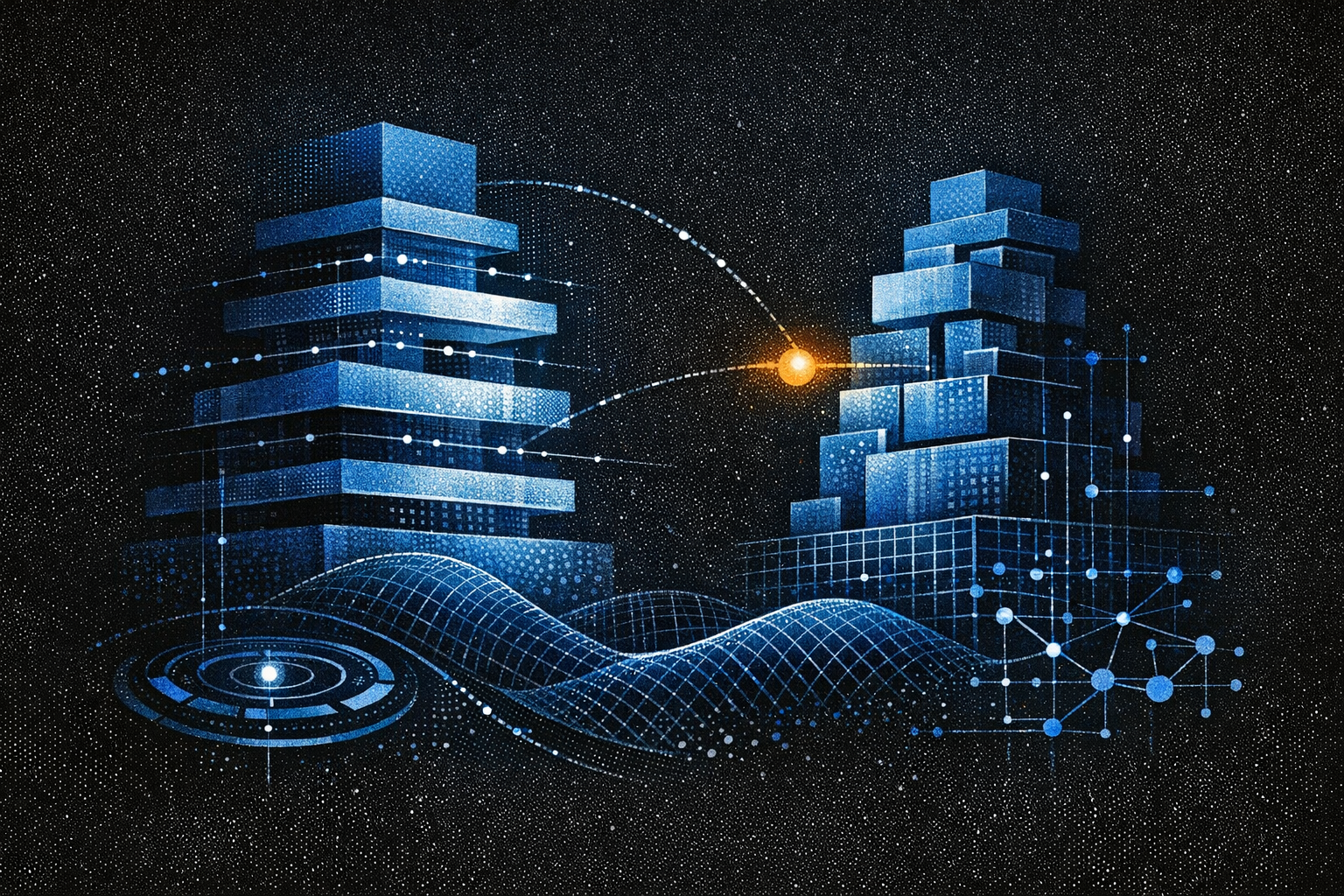
Here's the structural difference:
Lateral vs Vertical
This is the key engineering distinction.
When Google traffic collapsed, Future had to build laterally. Hawk stopped working → build Signal for social and LLMs. SEO stopped working → build Future Optic for ChatGPT visibility. Each channel transition produces a new product that must be staffed, maintained, and monetized independently. The engineering cost scales with the number of channels.
When Google traffic collapsed, People Inc expanded vertically. D/Cipher's contextual understanding — trained on 100 million content-entity connections — doesn't break when sessions decline. The same intelligence that targets ads on allrecipes.com also powers D/Cipher+ on third-party sites, also informs licensing deals with OpenAI and Meta, also shapes the agent surface layer for the agentic web. One investment, multiple applications.
The lateral pattern: new channel → new product → new team → new revenue line.
The vertical pattern: new surface → same intelligence → incremental cost → additional revenue line.
This is not abstract. Future's engineering org has to build and maintain seven distinct products. People Inc's engineering org maintains one knowledge graph and one intelligence layer, then deploys them to new surfaces at marginal cost. The 800 engineers spread across four geographies can focus on deepening the graph rather than rebuilding for each new distribution channel.
Helix vs D/Cipher
The most interesting direct comparison. Both use AI for ad targeting. Both are proprietary. Both launched within the same window.
But they're solving different problems.
| Dimension | Helix (Future) | D/Cipher (People Inc) |
|---|---|---|
| Core question | Who is about to buy? | What is this content about? |
| Signal source | User behavior (Aperture first-party data) | Content semantics (Graphene-Selene) |
| Scales with | Traffic volume (more users = better predictions) | Content volume (more pages = richer graph) |
| When sessions decline | Signal quality degrades | Signal quality unchanged |
| Privacy model | First-party behavioral (consented) | Contextual (no user data needed) |
| Extension potential | Limited to owned properties | D/Cipher+ extends to third parties + CTV |
Helix is audience intelligence. It predicts which users are likely to convert based on behavioral signals across Future's 175+ brands. The 21% CTR improvement in testing is real. But behavioral signals are traffic-dependent. When sessions drop 15%, the prediction model has 15% less data to work with. And Helix can't easily extend beyond Future's owned properties — the behavioral data doesn't travel.
D/Cipher is content intelligence. It understands what an article means — the entities, topics, relationships, brand-safety context — independent of who's reading it. The understanding survives session declines because the content doesn't change. And because it's content-based rather than audience-based, it can extend to any publisher's content through D/Cipher+.
Neither is wrong. They're different bets on which signal matters more in a post-cookie, post-search world. Audience-centric intelligence works brilliantly when you have the traffic. Content-centric intelligence works when you don't.
The Dependency Problem
Both stacks have a critical vulnerability. They're just different vulnerabilities.
Future's risk is channel dependency. The stack is self-contained — Future built all seven products in-house. No external AI vendor controls the core. But every product is coupled to a specific distribution channel. When a channel declines (Google search: −15% sessions, web affiliate: −27% revenue), the product tied to it declines in lockstep. Future is perpetually rebuilding for the next channel.
People Inc's risk is vendor dependency. The understanding layer is channel-independent, but D/Cipher runs on OpenAI's models. OpenAI is building its own advertising platform. People Inc's most important technology partner is becoming a competitor. The intelligence layer survives channel shifts — but it might not survive the vendor becoming a rival.
Future plc — Channel Risk
Channels shift → products break → rebuild for new channel → repeat. Self-contained but coupled to distribution dynamics outside your control. The engineering cost is proportional to the number of channel transitions.
People Inc — Vendor Risk
Intelligence survives channel shifts → but the intelligence depends on a vendor who is becoming a competitor. Channel-independent but coupled to a technology partner's strategic decisions.
The Engineering Lesson
The lesson is not "understanding tech is better than visibility tech." It's that the layer you build on determines how your engineering investment compounds.
Future built on channels. Every piece of technology is optimized for a distribution endpoint. This works beautifully when channels are stable (Future grew to a £4B market cap when Google search was reliable). It's expensive when channels are volatile (£4B → £300M).
People Inc built on content. The knowledge graph and semantic engine are investments that deepen over time regardless of distribution dynamics. This pays off slowly — the market still values People Inc's technology at approximately zero — but the investment compounds vertically rather than depreciating laterally.
For any technology leader at a media company making this choice: the question isn't which stack is better today. It's which one you want to be maintaining in three years, when the channels have shifted again and we're all optimizing for whatever comes after the current wave of AI browsers.
Future will build an eighth product. People Inc will deploy the same graph to a fourth surface.
The business analysis is at people.karaxai.com. Sources: Future Helix launch, Future H1 2026 results, Press Gazette on Future tech, MarTech360 on Helix, Digiday on DDM tech integration.